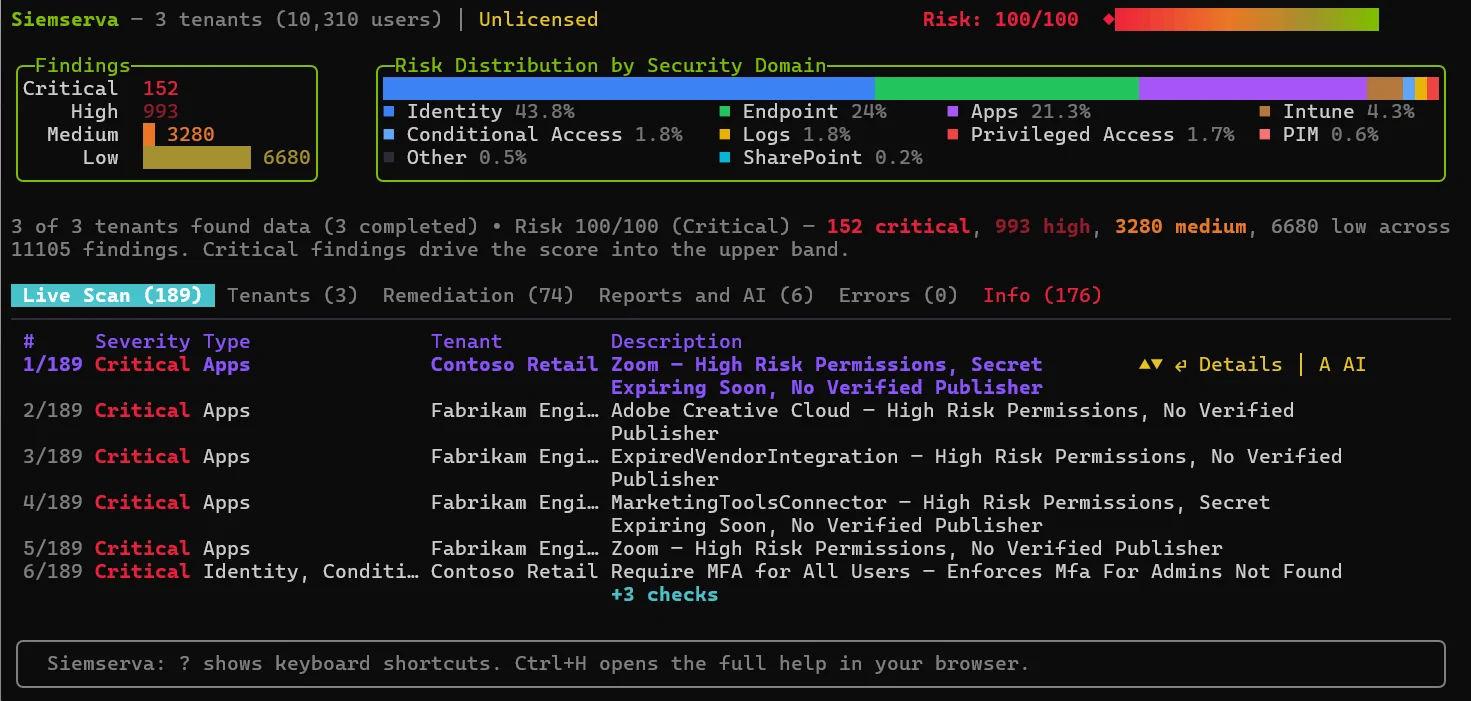
If you are staring at a vulnerability report and trying to figure out what to actually fix, the list itself is not giving you enough to work with.
Here is the problem most IT and security teams run into: a CVE scan returns hundreds of findings. Everything gets a CVSS score, Critical, High, Medium, Low. And somewhere in that stack of Criticals, one is actively being used to deploy ransomware right now, and another probably will not matter for years. CVSS alone cannot tell you which is which. That is where most vulnerability programs fall apart.
If you are the one running the scans
IT managers, security engineers, and MSPs managing Microsoft environments: this is your problem. You do not have time to research every CVE that comes out of a scan. You need to know what to fix today, what can wait until next patch cycle, and what you can probably deprioritize.
The same goes for compliance. When your auditor asks about your patch posture, "we have a list" is not an answer. A defensible, prioritized plan is. See how the compliance mapping works.
The signal that actually matters
CISA KEV, the Known Exploited Vulnerabilities catalog, is the list of CVEs confirmed to be actively exploited in the wild right now. Not theoretical risk. Not "could be exploited in certain conditions." Actually being used against real organizations. If a CVE is on KEV, it moves to the front of the line. Full stop.
From there, EPSS, the Exploit Prediction Scoring System, gives you a daily-updated probability that a given CVE will be exploited in the next 30 days. So even if something is not on KEV yet, you can see what is trending toward becoming a problem.
Stack those two signals on top of CVSS severity, how long the exposure has been open, and how much of your environment is affected, and now you have a prioritization order you can actually defend.
What Senserva does
Senserva pulls CVE data from every authoritative source at once: NVD (NIST), CISA KEV, EPSS from FIRST.org, Microsoft MSRC Patch Tuesday data, and Microsoft Defender Threat and Vulnerability Management where you have it licensed. Every CVE gets enriched with the full picture, not just a severity number, but whether it is actively exploited, how likely exploitation is, which ransomware groups are associated with it, and which devices on your network are missing the patch that fixes it.
Then it ranks them. Actively exploited first, by severity and EPSS probability from there, in an order you can defend to an auditor or a CIO. You can search the Microsoft CVE lookup and the patch tracker for free, no sign-up.
CVE and patch capabilities are rolling out in phases, with more landing in the next release. If you want to know exactly what is available today and what is coming, reach out directly. We will tell you straight.
And because this is not a standalone vulnerability scanner, it is the same scan that checks your configuration posture and reads your logs, a missing patch on a misconfigured, actively-probed device surfaces differently than the same patch gap on a well-hardened machine. The full picture matters. That is the unified security model.
The patch management DNA
This is where Senserva's history is worth knowing. Mark Shavlik built HfNetChk, which became the foundation for Microsoft's Baseline Security Analyzer (MBSA), and then built Shavlik Technologies, which invented automated patch management as an industry before being acquired by VMware. That background is not just a footnote. It is why the patch and vulnerability work in Senserva is built differently than what you would get from a company that bolted on a CVE feed as an afterthought. More on the Shavlik patch heritage.
Ask Claude about it
Senserva stores all of its enriched CVE data locally, which means Claude can answer questions about your environment in plain language through the Senserva MCP: "Which missing patches fix CISA KEV CVEs?" or "What are the top exploited vulnerabilities on my environment, and what is the remediation plan?"
The answer comes back as a plan, not a data dump. And because the data lives locally rather than requiring live lookups, responses are fast and token costs stay low. The MCP is a Claude integration: if you are already running Claude Desktop, you are one connection away from querying your full security posture by asking a question. See Claude and the Senserva MCP.
The bottom line
CVE management should not be a research project. It should be a ranked list with clear triage logic, attached to the rest of your security picture, and queryable by you or your AI without a separate tool or a separate workflow.
That is what we built. And given where we came from, it was probably inevitable.
See the Microsoft CVE lookup and patch cross-reference, or run Senserva against a free demo tenant.